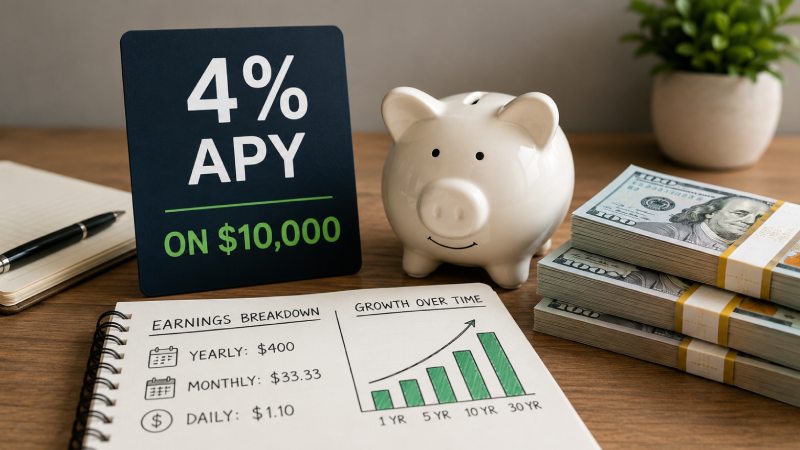
A 4% APY on a $10,000 principal deposit generates exactly $400 in interest over one year, bringing your total balance to $10,400. This equates to approximately $33.33 in interest per month or roughly $1.10 every day.
Because Annual Percentage Yield (APY) accounts for the effects of compounding interest, this return remains identical regardless of whether your bank compounds daily or monthly.
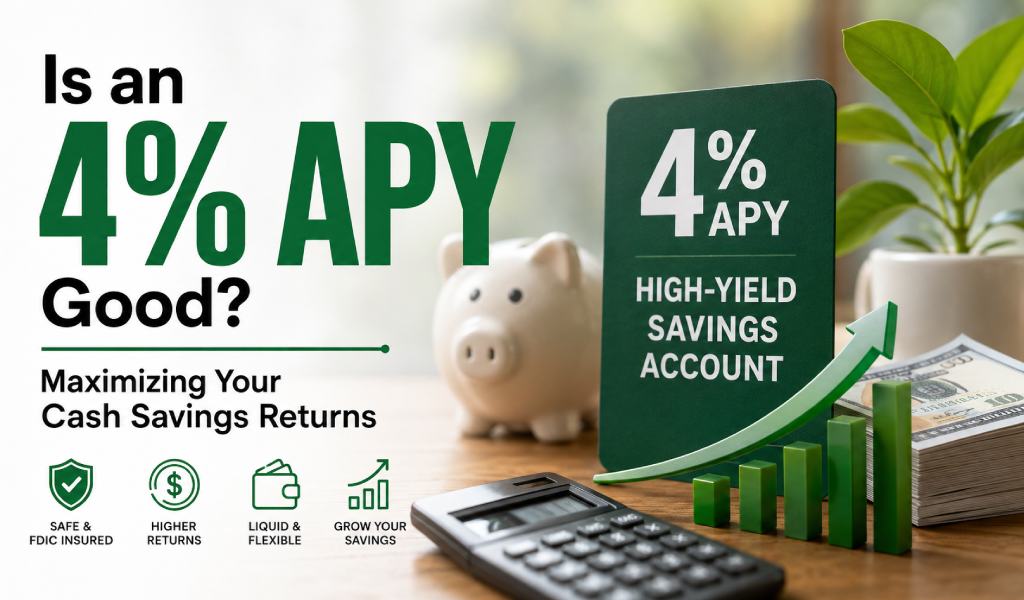
While traditional banking rates often linger near 0.01%, a 4% yield represents a high-performing, risk-free vehicle that significantly outpaces national averages to protect your liquid cash.
Calculating Your Yearly and Monthly Returns
Understanding how interest accumulates is the first step toward effectively managing your liquid capital. We will now examine exactly how these earnings manifest over specific timeframes to help you budget.
Annual Interest Breakdown
On a $10,000 deposit, your annual return is fixed at exactly $400.00. The APY formula is standardized to reflect a one-year period, meaning your ending balance will be $10,400 after twelve months.
This calculation provides a clear benchmark for evaluating the efficiency of your current savings strategy compared to other market-leading financial products.
Monthly and Daily Earnings
Your monthly average earnings will be $33.33, calculated by dividing the total annual interest by twelve. On a more granular level, you can expect to see your account grow by approximately $1.10 per day.
While daily compound variation might cause the first month to yield roughly $32.74, the monthly payouts will steadily increase as your balance compounds.
APY Earnings Calculator
Calculate your savings growth with compound interest.
How 4% APY Compares to Traditional Savings
Maximizing your yield requires looking at the broader economic landscape. By comparing 4% APY to standard market offerings, you can see the massive difference in interest income generated by modern accounts.
Beating the National Average
The national average savings account yield currently sits at 0.38% APY according to FDIC tracking data. At this rate, a $10,000 deposit earns only $38 per year, which is a fraction of the $400 earned at 4%. Choosing a higher rate ensures that your money works significantly harder for you while remaining accessible.
High-Yield vs. Brick-and-Mortar Banks
Traditional major institutions frequently offer baseline rates near 0.01% APY, yielding a negligible $1 per year on a $10,000 balance. In contrast, top-tier digital banking alternatives often provide 4.00% to 4.50% APY, resulting in returns that are 400 times higher than those of typical brick-and-mortar competitors.
The Long-Term Power of Compounding Interest
If you maintain your balance across a longer timeline without making extra withdrawals, your money continues to grow exponentially. This “set and forget” strategy allows interest to earn even more interest over time.
| Timeline | Total Interest Accrued | Final Account Balance |
|---|---|---|
| 1 Year | $400.00 | $10,400.00 |
| 2 Years | $816.00 | $10,816.00 |
| 3 Years | $1,248.64 | $11,248.64 |
| 5 Years | $2,166.53 | $12,166.53 |
| 10 Years | $4,802.44 | $14,802.44 |
| 30 Years | $22,433.98 | $32,433.98 |
Understanding APY vs. APR Mechanics
Distinguishing between these two terms is vital for any sophisticated saver. We will clarify how these metrics differ so you can accurately assess the true growth potential of your assets.
Why Compounding Frequency Matters
The primary difference is that APY accounts for compounding while APR ignores it. Because APY is a standardized figure representing the true annual return, your $400 payout stays the same whether the bank compounds daily or quarterly.
This ensures that savers can make apples-to-apples comparisons between different financial institutions without complex manual math.
Standardizing Your Return Potential
Using APY allows you to see the actual yield you will receive after one year of interest being added back to the principal. While a higher compounding frequency technically yields more over time, the APY figure already incorporates that extra growth into its percentage.
This makes it the most transparent metric for evaluating high-yield savings accounts and certificates of deposit.
Is a 4% APY Really a Good Rate for You?
When evaluating if a 4% return fits your goals, you must consider its role in your portfolio. This rate is widely considered excellent for a risk-free return on liquid funds.
Safety and Liquid Access
A 4% APY is an excellent rate for safeguarding liquid cash, making it perfect for accessible emergency funds. It crushes traditional accounts and provides growth that requires zero active ongoing management.
While some peak digital accounts might reach up to 4.50%, the 4% threshold remains a strong benchmark for stability and performance.
Market Peak Comparison
While the return is significant, it is important to realize that high-yield savings rates are variable and shift based on Federal Reserve policy. If you want to lock in a guaranteed 4% return for an entire year regardless of market shifts, a 1-Year Certificate of Deposit (CD) may be a better alternative.
Critical Protections for Your Principal
Before depositing your hard-earned $10,000, you must ensure that your money is safe and that you understand the legal obligations. Protecting your assets involves both federal coverage and tax compliance.
- Federal Insurance: Ensure your chosen bank is fully backed by the Federal Deposit Insurance Corporation (FDIC) or the National Credit Union Administration (NCUA).
- Safety Limits: Your money is federally protected up to $250,000 per depositor, making a $10,000 deposit fully covered in the event of a bank failure.
- Tax Liability: The interest you earn is categorized as taxable income.
- IRS Documentation: Your bank will issue a Form 1099-INT if you earn more than $10 in a calendar year, which definitely applies to a $400 annual return.
- Liquidity: Most high-yield accounts allow for easy access to funds, unlike CDs which may have withdrawal penalties.
Maximizing Your $10,000 Investment Potential
To truly excel in wealth building, you should look for ways to accelerate your returns beyond the initial deposit. Small adjustments in your behavior can lead to significantly larger balances over several decades.
- Automate Recurring Deposits: Adding monthly funds to your account can drastically accelerate the compounding effect over time.
- Review Variable Terms: Since savings rates fluctuate with the market, check your account monthly to ensure it still meets the 4% benchmark.
- Reinvest Interest: Avoid withdrawing the $33.33 earned each month; leaving it in the account allows the interest to compound.
- Benchmark Regularly: Compare your current rate against top-tier digital banks to ensure you aren’t missing out on yields as high as 4.50%.
- Strategic Planning: Use high-yield accounts for your emergency fund while moving long-term excess cash into higher-risk/higher-reward vehicles.
FAQ: Common Questions About 4% Returns
How much interest will $10,000 earn in a month?
On average, a $10,000 deposit at a 4% APY will earn $33.33 per month. This is a simple division of the $400 annual interest by twelve months. The exact amount might vary slightly each month depending on the number of days, but the annual total remains consistent.
Is 4% APY a good rate for a savings account?
Yes, 4% is considered an excellent rate for a risk-free return. It heavily outperforms traditional bank options and the national average. While it is slightly under the peak rates of 4.50% offered by some online-only banks, it remains a highly competitive and safe way to grow your cash.
How much will $10,000 be worth in 30 years?
If left untouched at a steady 4% APY, your account will grow to $32,433.98 over 30 years. This means your principal more than triples through the power of compounding without requiring any additional deposits or active management.
Is the interest on $10,000 taxable?
Yes, the interest earned on your deposit is taxable income. Since you will earn $400 in a year, which is well over the $10 threshold, your bank will issue a Form 1099-INT for your tax filings.
Conclusion
Investing $10,000 at a 4% APY is one of the most effective ways to manage an emergency fund or liquid savings. By earning $400 annually—or roughly $33.33 every month—you ensure your capital is not losing value to the low rates offered by traditional institutions.
While the market fluctuates, maintaining a high-yield account backed by federal insurance remains a cornerstone of a responsible and high-performing financial plan.
Whether you choose a flexible savings account or a fixed CD, the power of compounding interest will turn your $10,000 into a significant asset over the coming decades.