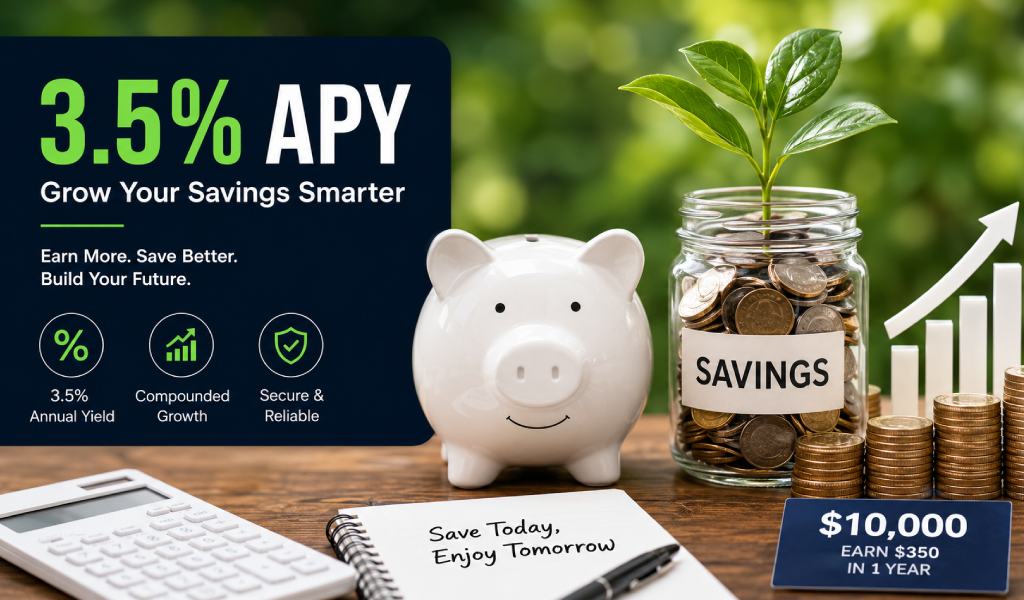
A 3.5% APY means you will earn exactly 3.5% total return on your capital over one full year, fully accounting for the effects of compounding interest. For instance, a $1,000 deposit at this rate generates $35.00 in passive earnings annually, resulting in a total balance of $1,035.00.
This metric reflects the true yield of an account, unlike the base interest rate, by including interest earned on prior interest payments.
In today’s competitive landscape, this rate represents a high-yield opportunity that significantly outperforms the national average, providing a reliable path for wealth preservation and growth.
Understanding the Mechanics of a 3.5% APY Return
Grasping the underlying math of annual yields is essential for any modern investor looking to optimize their cash reserves. These mechanics determine how quickly your money grows and how different financial products compare against each other.
The Core Distinction Between APY and APR
The Annual Percentage Yield (APY) reflects your true annual return because it includes the effect of earning interest on top of previous interest payments.
In contrast, the Annual Percentage Rate (APR) only reflects the base rate. For example, a 3.44% APR compounded monthly results in a 3.50% APY. Understanding this allows you to compare different accounts accurately.
How Compounding Frequency Affects Total Earnings
While the headline rate is 3.5%, the frequency at which interest is calculated—daily, monthly, or quarterly—impacts the speed of growth. Most competitive financial institutions compound interest daily or monthly to push your balance up faster.
Frequent compounding ensures that your earned interest begins generating its own return almost immediately, maximizing the efficiency of your deposited funds.
Projections and Growth Tables for 3.5% Yields
Visualizing how these percentages translate into actual dollars helps in setting realistic financial goals. By applying a consistent yield to different balance tiers, you can project exactly how your emergency fund or investment capital will expand over time.
Strategic cash management requires looking at both short-term gains and long-term accumulation. The following data points illustrate the guaranteed growth of various deposit amounts over a one-year timeline, assuming no additional contributions are made to the principal balance.
| Initial Deposit Amount | Interest Earned (Year 1) | Total Ending Balance |
|---|---|---|
| $1,000 | $35.00 | $1,035.00 |
| $5,000 | $175.00 | $5,175.00 |
| $10,000 | $350.00 | $10,350.00 |
| $50,000 | $1,750.00 | $51,750.00 |
Data based on standard 3.5% APY calculations over a 12-month period.
The Exponential Power of Multi-Year Compounding
When you leave capital untouched for several years, the speed of growth increases because your interest earns interest in an accelerating cycle. For a $10,000 deposit, the first year earns $350, but by the second year, you earn $362.25 because you are calculating 3.5% on the new, higher balance. By the fifth year, your total reaches $11,876.86 without adding a single extra dollar.
3.5% APY Yield Calculator
Estimate your compounded savings growth over time.
Comparing Estimated Returns Against Traditional Rates
A 3.5% return is approximately nine times higher than the national average, which hovers near 0.38%. At a traditional big bank offering only 0.01%, a $1,000 deposit earns a mere $0.10 over a full year. Choosing a high-yield option over a standard account represents a significant shift from stagnant capital to active wealth generation.
Is 3.5% APY a Good Interest Rate Today?
Evaluating whether a rate is “good” depends heavily on the current economic climate and the specific purpose of the funds. What qualifies as high for a saver might be considered low for a borrower.
Current market conditions place this rate in a highly competitive category for liquid cash. While absolute peak rates might be slightly higher, 3.5% remains a solid benchmark for those seeking a balance between high returns and accessibility.
Comparing Yields Against the National Average
The Federal Reserve’s benchmark rates often dictate what banks can offer to consumers, and a 3.5% rate aligns closely with these institutional baselines.
This makes it a “high-yield” choice compared to the 0.01% found at many massive brick-and-mortar institutions. It is a robust rate for maintaining liquidity while still growing your net worth significantly faster than the average saver.
Differentiating Savings Rates from Borrowing Rates
The perception of 3.5% changes based on whether you are earning or paying. For a savings account, it is considered high and beneficial.
However, if you were to find a mortgage or an auto loan at 3.5%, it would be considered incredibly low and a massive financial win for the consumer. Context is everything when determining the value of an interest rate.
Maximizing 3.5% APY on Savings vs. Trading Platforms
Investors have multiple avenues to capture this yield, ranging from traditional banks to innovative trading exchanges. Each environment has its own set of rules regarding how interest is earned and how capital is protected.
Choosing the right platform involves balancing the need for government-backed safety with the desire to eliminate opportunity costs while actively participating in the markets. Each path offers unique advantages depending on your financial strategy.
The Safety and Liquidity of Traditional Savings
High-yield savings accounts offer a standard reward for letting a bank hold your funds, with interest typically paid out monthly. These accounts are highly liquid, allowing you to withdraw or transfer cash at any time without penalty. They serve as an ideal safety net for emergency funds since they provide both growth and immediate accessibility.
Earning on Active Capital with Event Trading
Some trading platforms offer a unique double-earning feature where you earn interest on both idle cash and active trading contracts. This eliminates the “opportunity cost” of having money tied up in unresolved market positions.
On these platforms, interest is often calculated based on your total portfolio value rather than just the cash sitting in your balance.
Safety Protocols and Regulatory Protections
Traditional bank accounts are typically backed by the federal government and insured up to $250,000 via FDIC insurance. In contrast, trading platforms may hold funds under CFTC segregation rules.
While this separates your money from corporate funds, it does not provide the same government clearing safety net as a brick-and-mortar bank.
Potential Drawbacks and Hidden Costs to Consider
Even a high interest rate can be undermined by external economic factors and institutional fees. To truly maximize your 3.5% return, you must account for the “friction” that can erode your real-world gains.
Protective financial management requires looking beyond the headline percentage to the net result. Factors like inflation, taxation, and account maintenance can significantly alter the actual value of the interest you receive over time.
The Invisible Impact of Inflation on Purchasing Power
If the cost of living is rising at 4% while you are only earning 3.5%, your money is technically losing purchasing power despite the nominal growth. Inflation acts as a hidden tax on savings. While 3.5% helps mitigate these effects better than a standard account, it may not always result in a real-term profit.
Managing Tax Liabilities and Annual Maintenance Fees
Interest earned is considered taxable income by the IRS and is taxed at your standard federal and state brackets. Banks will issue a 1099-INT form if your earnings exceed $10 in a year. Furthermore, a small monthly fee, such as $5, can completely wipe out the annual interest earned on smaller balances like $1,000.
How to Successfully Capture a 3.5% Yield
Securing a high rate requires a proactive approach to account selection and management. By understanding the fine print and automating your processes, you can ensure that your money is always working at its highest potential.
Implementation is the final step in moving from theory to reality. Whether you prefer the stability of a fixed term or the flexibility of a variable account, there are specific steps to take to lock in your returns.
Deciding Between Variable and Fixed Rate Accounts
A high-yield savings account typically offers a variable rate, meaning the bank can lower it if the Federal Reserve cuts interest rates. If you want to guarantee a 3.5% return for a specific timeframe, you should look for a Certificate of Deposit (CD). A CD legally locks in the rate for the duration of the term, regardless of market shifts.
Automating Growth and Meeting Minimum Requirements
To maximize your average daily balance, link your accounts and transfer funds immediately after payday. This ensures every dollar starts earning interest as soon as possible. Always check the fine print for minimum balance requirements; some platforms require a minimum of $250 or more to trigger interest tracking and avoid fee penalties.
Frequently Asked Questions About 3.5% Returns
Is 3.5% APY considered a high interest rate?
Yes, it is highly competitive. It is nearly nine times higher than the national average and significantly better than the 0.01% rates found at many major traditional banks.
How much will $10,000 earn in one year at 3.5% APY?
A $10,000 deposit will earn exactly $350.00 in interest over twelve months, bringing your total ending balance to $10,350.00.
What is the difference between earning interest at a bank vs. a trading platform?
Banks pay interest only on uninvested cash and offer FDIC insurance. Some trading platforms pay interest on both idle cash and active trading contracts but use CFTC segregation instead of FDIC insurance.
Can the 3.5% rate change after I open the account?
If the rate is on a savings account, it is usually variable and can change based on market conditions. If the rate is on a Certificate of Deposit (CD), it is locked for the duration of the term.
Will I have to pay taxes on the 3.5% interest I earn?
Yes. Interest earnings are treated as taxable income. Your financial institution will provide a 1099-INT form at the end of the year if you earn more than $10.
Strategic Conclusion: Putting Your Capital to Work
Achieving a 3.5% APY is a milestone in moving from basic saving to sophisticated cash management. By understanding that this rate includes compounding, you can better project your future wealth and make informed decisions about where to store your capital.
Whether you choose the government-guaranteed safety of a high-yield savings account or the dual-earning potential of an event trading platform, the key is to minimize fees and maximize the time your money spends in the account.
By automating your deposits and keeping a close eye on inflation and taxes, you ensure that a 3.5% yield becomes a powerful engine for your long-term financial success.