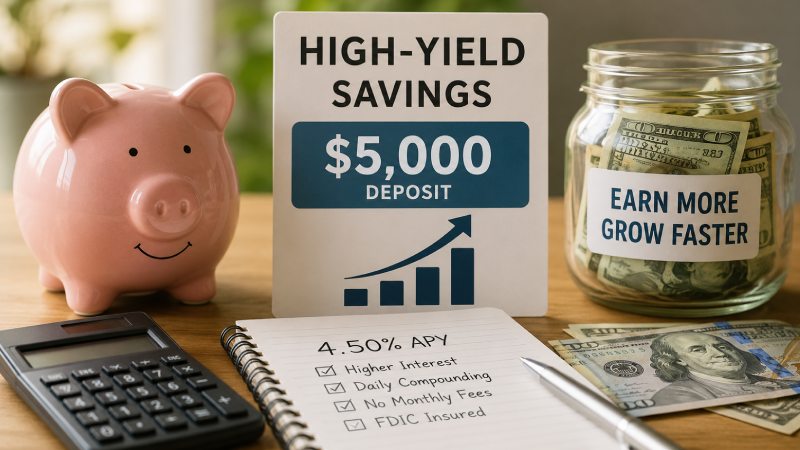
A $5,000 deposit in a top high-yield savings account makes between $200 and $225 in interest annually, assuming current peak rates of 4.50% APY. This return significantly outperforms traditional bank averages of 0.38%, which generate only $19 in the same period.
By selecting accounts with daily compounding and no maintenance fees, you can maximize every cent of your principal.
This guide analyzes exactly how $5,000 grows over time, the impact of market fluctuations, and the most effective strategies to turn that initial deposit into $10,000 through automated contributions and active capital management.
Immediate Earnings Projections for a $5,000 Deposit
Understanding the mathematical trajectory of your money is the first step toward building significant liquid wealth. Below, we examine the specific performance metrics across different timeframes and interest rate environments to guide your choice.
High-Yield Savings Calculator
Annual Interest Yields Based on APY
For a one-year horizon, a $5,000 deposit at a 4.50% APY yields approximately $225, whereas a 4.00% rate produces $200. In stark contrast, keeping those funds in a traditional brick-and-mortar institution often results in less than $20 annually.
This disparity illustrates the "opportunity cost" of convenience, where choosing the right digital-first institution effectively pays for a week’s worth of groceries purely through interest earnings.
Long-term Compound Growth Expectations
Over five years, the power of compounding transforms your initial $5,000 into a much larger reserve. A market leader offering 4.50% APY will generate $1,230.91 in total interest, bringing your final balance to over $6,230. Meanwhile, a conservative savings account at 0.38% would only grow to $5,095.72.
This massive gap highlights how vital it is to secure the highest possible rate early in your savings journey to benefit from geometric expansion.
Core Variables Impacting Your Cash Balance
While the headline interest rate is important, several mechanical factors determine how much of that interest actually stays in your pocket. These variables can either accelerate your growth or quietly diminish your returns over time.
The Efficiency of Compounding Schedules
Compounding frequency is a critical technical detail; interest can be calculated daily or monthly. Accounts that utilize daily compounding are superior because your earned interest starts generating its own interest almost immediately.
While the difference on $5,000 might seem like a few cents initially, these fractional gains compound over decades into substantial amounts, making daily compounding a non-negotiable feature for sophisticated savers.
Managing Variable Market Interest Rates
Unlike fixed-term certificates, high-yield accounts feature variable rates that the bank can change at any time. These rates are typically sensitive to the Federal Reserve’s benchmark decisions.
If the Fed raises rates, your bank will likely increase your APY, but a rate cut will lead to a decrease in your monthly earnings. Monitoring these shifts ensures you are always positioned in an account that remains competitive as economic conditions evolve.
Factoring Federal Income Tax Obligations
It is essential to remember that the IRS treats the interest you earn as regular taxable income. If your $5,000 deposit earns more than $10 in a year, your financial institution will issue a Form 1099-INT. You must report these earnings on your tax return, and they will be taxed at your standard bracket rate. This tax liability means your "net" profit will be slightly lower than the gross interest shown on your statement.
Strategic Comparison of High-Interest Banking Providers
Choosing the right partner for your $5,000 involves balancing the interest rate against the requirements for maintaining that rate. Digital banks generally offer the highest yields because they lack the overhead costs of physical locations.
Specialized Institutional Performance Rates
SoFi Bank currently leads the market with a peak rate of 4.50% APY, though this specifically requires a direct deposit setup to unlock the full benefit. Another competitive option is OMB Bank, which offers 4.26% APY, though this rate is often part of a promotional period, such as a 60-day guarantee.
These high-performance accounts are ideal for users who are comfortable with automated banking and direct deposit integration to maximize their returns.
Entry-Level Accessibility for New Savers
For those who prefer a simpler approach without direct deposit requirements, Forbright Bank offers 4.15% APY with no minimum deposit to open or maintain the account.
This type of account is perfect for a one-time $5,000 deposit that you intend to leave untouched without jumping through administrative hoops. Prioritizing "no-fee" structures ensures that your interest growth is never offset by monthly maintenance charges or low-balance penalties.
Navigating Liquidity and Transaction Limits
Maintaining access to your capital is just as vital as the interest it earns. Balancing high yields with the flexibility to withdraw funds ensures your savings remain a tool for financial security rather than a locked asset.
Accessing Funds for Emergency Reserves
High-yield accounts offer high liquidity, typically allowing up to six penalty-free withdrawals per monthly cycle. This makes them ideal for emergency funds where immediate access to your $5,000 is necessary.
However, users should remain aware of potential "excessive transaction" fees that some institutions impose if these monthly limits are breached. This flexibility is the primary advantage over Certificates of Deposit (CDs), which often penalize any early withdrawal.
Protection Against Economic Volatility
Your $5,000 acts as a liquid cushion that is 100% safe from market crashes and stock volatility. Because these funds are held in cash-equivalent accounts, they provide a level of security that speculative assets cannot match.
This stability is essential for short-term goals where you cannot afford to see your principal balance decrease. Ensuring your money is in a low-risk environment allows you to focus on growth without the stress of market timing.
Proven Methods to Double Your $5,000 Capital
If your goal is to grow your $5,000 into $10,000, relying on interest alone would take approximately 16 years. To speed up this timeline, you must implement more aggressive strategies that combine high-yield tools with active contributions or managed risk.
The High-Contribution Savings Path
The most reliable way to double your money quickly is the "match" strategy. By placing your $5,000 in a 4.50% APY account and contributing $350 every month, you will cross the $10,000 threshold in just 13 months.
This approach utilizes the high-yield account as a storage vessel while your labor-driven contributions act as the primary engine for balance growth. It is the lowest-risk method to hit your five-figure goal.
Passive Market Investment Growth
For a hands-off approach, moving the $5,000 into a broad-market index fund, such as one tracking the S&P 500, offers a historical average return of 10% annually. At this rate, your capital would double passively in roughly seven years.
While this carries more risk than a savings account, it is a standard method for long-term wealth building where the timeline is less urgent than the desire for significant appreciation.
Active Asset Flipping for Rapid Gains
The fastest, though highest-risk, method involves using the $5,000 as inventory capital for reselling goods. By purchasing underpriced items like electronics or liquidation pallets and selling them for a 20% profit margin, you could theoretically double your money in under five months.
However, this requires significant personal time, market knowledge, and the risk that inventory may not sell as expected, making it a "business" strategy rather than a passive one.
Essential Safety and Performance Checklist
Before finalizing your deposit, follow these steps to ensure your funds are protected and your account is optimized for maximum earnings.
- Confirm Federal Insurance: Always verify that the institution is explicitly backed by the FDIC or NCUA. This provides a legal guarantee for your $5,000 up to $250,000 per depositor.
- Audit the Fee Schedule: Review the fine print for "monthly maintenance fees" or "low balance penalties" that could eat into your interest.
- Establish Daily Compounding: Choose banks that calculate interest daily to ensure your earnings grow at the fastest possible frequency.
- Enable Automated Transfers: Set up a recurring ACH transfer from your primary checking to increase your principal balance without manual effort.
- Track APY Trends: Periodically compare your current rate against market leaders to ensure your bank hasn't significantly lagged behind competitors.
- Prepare for Taxes: Keep a record of your earned interest and expect a 1099-INT form if your annual earnings exceed $10.
Frequently Asked Questions on $5,000 Deposits
How much interest will I earn on $5,000?
In a top-tier account (4.50% APY), you will earn about $225 in one year, compared to just $19 in a traditional bank.
What happens if the bank fails?
As long as the bank is FDIC or NCUA insured, your $5,000 is 100% protected and guaranteed by the federal government.
Can I withdraw my $5,000 at any time?
Yes, high-yield accounts are liquid, typically allowing up to 6 withdrawals per month without any penalty.
Does the interest rate stay the same?
No, these are variable rates. They will fluctuate based on the broader economy and Federal Reserve policy changes.
Is $5,000 enough to start with?
Absolutely. Many top-tier banks have no minimum deposit requirements, making $5,000 an excellent starting point for a growth strategy.
Final Strategic Outlook for Liquid Savings
Choosing to move your $5,000 from a traditional bank to a high-yield savings account is one of the simplest yet most effective financial upgrades you can make. By capturing a 4.50% APY instead of 0.38%, you are essentially giving yourself a 1,100% raise on your passive earnings.
Whether you use this account as a permanent emergency fund or a temporary staging ground for future investments, the combination of federal protection and daily compounding ensures your money is working as hard as possible.
Consistent monitoring of rates and the addition of modest monthly contributions will further accelerate your journey from a $5,000 base to a $10,000 milestone.