If you deposit $10,000 into a competitive six-month Certificate of Deposit (CD), you will earn between $200 and $218 in guaranteed interest by maturity. However, this premium return requires using a high-yield online financial institution offering annual yields of 3.95% to 4.40%.
Traditional brick-and-mortar commercial banks yield a national average of only 1.41% to 1.50%, slashing your earnings to a mere $70 to $74.
Understanding how term limits, annual percentage yields, and daily compounding affect your payout ensures you maximize every dollar of your principal investment.
The Real-World Earnings on a $10,000 6-Month CD
Your actual earnings are driven by three fundamental mathematical factors: your deposit size ($10,000), the term length (6 months), and the Annual Percentage Yield (APY). Because APY measures earnings over a full year, a six-month contract earns approximately half of that stated rate.
Selecting the right financial institution is the single most critical decision affecting your yield. Online banks bypass the heavy overhead of physical branches, passing those savings to consumers through significantly higher rates.
The table below provides a comprehensive breakdown of what a $10,000 deposit will yield across different bank tiers, based on actual market benchmarks from August 2026:
| CD Tier Type | Market APY Range | Interest Earned (6 Months) | Total Final Balance | Sample Financial Institutions |
|---|---|---|---|---|
| Top-Tier High Yield | 4.35% – 4.40% | $215.19 – $217.63 | $10,217.63 | Best national yields (e.g., Investopedia Best Rates) |
| Competitive Online | 4.05% – 4.20% | $200.49 – $207.84 | $10,207.84 | Happen Bank, E*TRADE, Popular Direct |
| Baseline Online | 3.95% – 4.00% | $195.60 – $198.05 | $10,198.05 | Marcus by Goldman Sachs, Bread Savings |
| National Average | 1.41% – 1.50% | $70.26 – $74.72 | $10,070.26 – $10,074.72 | Standard brick-and-mortar commercial banks |
As shown above, traditional brick-and-mortar networks severely limit your growth potential.
Moving your $10,000 to a top-tier digital provider earns you up to $147 more in just six months. This strategic choice ensures your hard-earned funds perform at their peak rather than sitting stagnant in low-yield traditional accounts.
Understanding How CD Interest Compounds and Accrues
To maximize your guaranteed savings, you must understand the underlying math driving your return. These specific compounding structures and calculation formulas dictate your exact final balance at maturity.
Daily Compounding Mechanics
Most competitive digital banks compute your interest via daily compounding. Every day, the financial institution calculates a small interest slice on your initial $10,000 principal plus your previously accumulated interest.
At the end of each month, this accumulated amount is officially deposited into your CD balance. When your six-month term wraps up, the entire compounded interest lump sum is paid out alongside your original principal.
The Impact of the Annual Percentage Yield Formula
Since banks utilize compound interest rather than simple interest, calculating your final payout requires specific mathematical formulas. The standard APY formula used to determine your exact balance at maturity is: Final Value = Principal × (1 + APY)^Years.
For partial years, you must convert months into fractions. A six-month term is calculated as half a year, or 0.5, which yields approximately half of the annual yield rate.
Base Interest Rate vs. APY Calculations
If your bank lists a base annual interest rate instead of an APY, the underlying daily compounding formula applies. This formula is written as: Final Value = Principal × (1 + r / 365)^(365 × t), where “r” is the interest rate as a decimal and “t” is the fraction of the year.
This detailed calculation captures the tiny daily increments that eventually compile into your final six-month payout.
Rules, Risks, and Penalties of a $10,000 CD
While a fixed-term certificate offers unparalleled security, it operates under rigid legal terms. Depositors must prepare for penalties, tax rules, and safety parameters before committing capital.
Early Withdrawal Penalty Costs
By opening a CD, you promise to leave your $10,000 untouched for exactly six months. If an unexpected emergency occurs and you withdraw early, you will face an Early Withdrawal Penalty.
On a six-month term, this standard penalty is typically 90 days of simple interest. If you withdraw early from a 4.15% APY CD, you lose roughly $103, and breaking it in the first month can eat into your principal.
Tax Obligations on CD Interest
The interest you earn on your deposit is not tax-free. Banks track your earnings and issue a Form 1099-INT at the end of the tax year if your interest exceeds $10. This money is taxed as ordinary income based on your specific federal and state tax brackets.
This is different from the lower long-term capital gains tax rates applied to standard stock market investments.
FDIC and NCUA Protection Limits
Despite withdrawal rigidity, CDs are among the safest investment vehicles available. Up to $250,000 per depositor is completely guaranteed against bank insolvency.
This protection is backed by the Federal Deposit Insurance Corporation (FDIC) for banks, or the National Credit Union Administration (NCUA) for credit unions. Checking for these logos ensures your $10,000 principal remains completely secure.
Alternative Strategies to Boost Your Short-Term Yields
Depending on your liquidity requirements and cash horizon, locking money for exactly half a year might not be your best path. Consider these alternative yield strategies instead.
High-Yield Savings Accounts for Liquidity
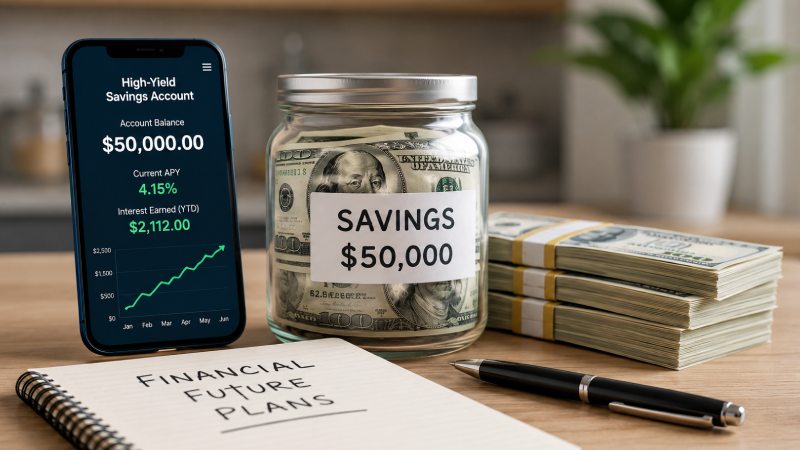
If you are hesitant about locking away your money due to potential emergencies, high-yield savings accounts are excellent options. Top accounts currently offer yields around 4.00% APY.
Your $10,000 will make nearly identical returns to a baseline CD but allows you to withdraw cash at any time without facing early withdrawal penalties. This ensures both peace of mind and constant liquidity.
Twelve-Month CDs for Extended Timelines
If you are certain you won’t need this cash for a full year, extending your timeline locks in your yield against future market adjustments.
Competitive twelve-month market rates hover between 4.10% and 4.30% APY, which will earn approximately $410 to $430. This longer timeline effectively doubles your total raw cash payout by the time the contract ends.
Short-Term Three-Month CDs
If six months feels too restrictive, a three-month CD offers a swifter path to liquidity while still yielding impressive returns.
With top-tier online banks offering three-month yields between 4.25% and 4.50% APY, a $10,000 investment will earn approximately $104 to $111 by maturity. This is a massive jump compared to traditional national averages of $35.
Long-Term Five-Year CD Strategy
If you want to lock in a rate for the long haul, depositing your funds for five years is another option. However, long-term five-year CDs currently yield slightly less than short-term CDs due to an inverted yield curve.
With top rates hovering around 3.80% to 4.00% APY, a $20,000 deposit left untouched for five years earns $4,100 to $4,330.
Common Questions About Six-Month CD Returns
How much will a $10,000 6-month CD make at traditional banks?
Depositing your money at traditional brick-and-mortar networks will result in significantly lower returns. Standard commercial bank averages hover around 1.41% to 1.50% APY, earning you only $70.26 to $74.72 in total interest.
This means you are sacrificing over $140 in potential yield by not utilizing a top-tier digital banking provider for your six-month financial contract.
Can my fixed interest rate drop during the six-month term?
No, one of the primary benefits of a Certificate of Deposit is its guaranteed, fixed rate of return. Once you open the account and deposit your $10,000, your annual percentage yield is legally locked in for the entire six-month duration.
Even if market rates fall across the banking industry, your specific payout remains completely insulated and unchanged.
What is the best way to avoid early withdrawal penalties?
The simplest way to avoid penalties is to match your CD term to your actual cash flow needs. If you suspect you might need emergency access to your $10,000 before the six-month mark, a high-yield savings account is a far better option.
Alternatively, you can build a CD ladder with staggered maturity dates to maintain periodic access to cash.
The Final Verdict: Is a 6-Month CD Worth It?
A six-month Certificate of Deposit is an outstanding tool for savers who want to lock in a high, guaranteed yield without committing their funds for a multi-year period.
With top-tier online institutions offering interest returns of $200 to $218 on a $10,000 principal, this low-risk vehicle easily outperforms traditional savings vehicles and keeps your capital safe from market volatility.
To make the most of this strategy, always compare current rates across multiple online platforms rather than settling for a local physical bank.
Ensure that your $10,000 is truly discretionary capital that you will not need to touch for the next 180 days, protecting you from costly early withdrawal penalties that can erode your accrued earnings.
If you desire maximum safety, fixed returns, and short-term growth, opening a high-yield six-month CD is one of the smartest financial moves you can make today.