
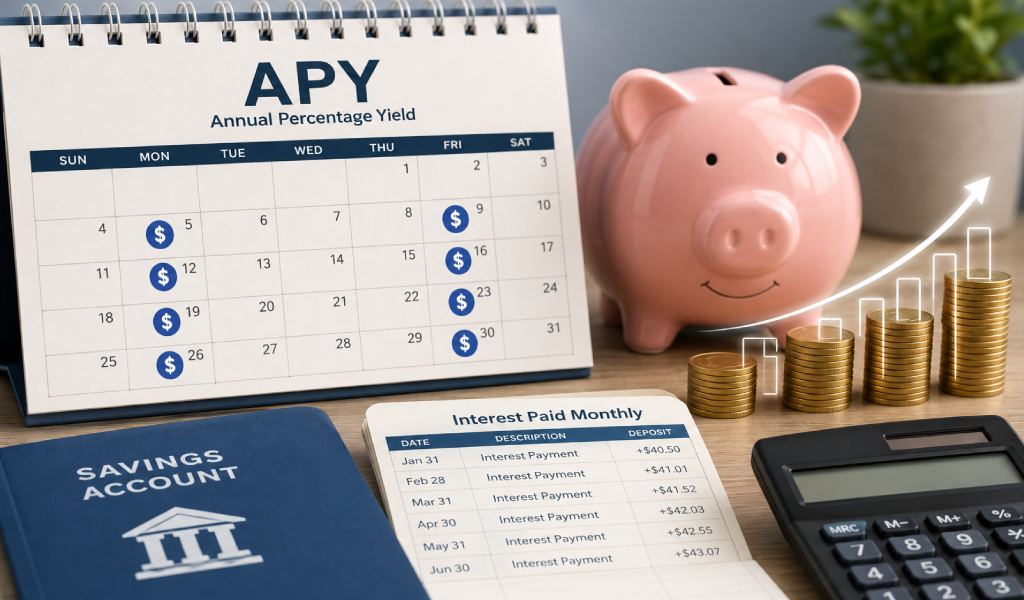
APY stands for Annual Percentage Yield, which is the total interest you earn over 12 months. While the metric is yearly, banks almost always pay interest monthly. You don’t have to wait a full year for your money; rather, the bank tracks your balance nightly to calculate daily accrual.
These daily earnings are then bundled and deposited into your account at the end of each statement cycle. This monthly payout schedule allows your interest to compound, meaning you earn interest on top of previous interest throughout the year.
Decoding the Frequency of Interest Payments
Understanding the timeline of bank earnings is essential for effective financial planning. While marketing materials highlight yearly figures, the operational reality of how your money moves follows a much more frequent, monthly rhythm.
Understanding the APY Monthly Payout Cycle
Most financial institutions operate on a monthly billing cycle for depositing interest into your account. Even though the APY is defined as an annual rate, the cash is credited to your balance every month.
This ensures that you have regular access to your earnings rather than having to wait for the entire 12-month period to conclude before seeing any profit.
Why APY is Always Expressed as a Yearly Rate
Financial transparency requires a standardized way to compare different accounts, which is why banks use the Annual Percentage Yield. This metric provides a clear picture of what your balance would earn after one full year of compounding.
By expressing the rate annually, it accounts for the mathematical benefits of receiving interest payments every single month throughout the year.
Identifying the Last Business Day Payout
Interest is typically credited to your account on the final business day of each month. This timing aligns with your monthly statement cycle, providing a consolidated view of all interest earned during that period.
Knowing this specific payout date helps savers track their growth and plan their monthly budget with a predictable influx of additional capital.
The Mathematical Foundation of Daily Accrual
To understand why you receive a specific amount each month, you must look at the hidden daily calculations. Financial institutions use a precise formula to track exactly how much your money earns every single night.
How Nightly Balance Tracking Works
Your bank performs a nightly check of your account’s ending balance to determine your daily earnings. Instead of waiting until the end of the month, the institution calculates interest on your funds every 24 hours.
This daily tracking ensures that any deposits or withdrawals made during the month are accurately reflected in your total monthly interest payment.
Calculating the 1/365th Daily Fractional Rate
The daily calculation involves dividing your advertised annual rate by the 365 days in a year. For example, if you have a 5.00% rate, the bank calculates roughly 1/365th of that percentage every day.
This fractional approach ensures that the interest grows steadily and aligns with the total annual projection once all days are accounted for.
Impact of Calendar Days on Monthly Totals
Monthly interest payments will vary slightly depending on whether the month has 28, 30, or 31 days. Since interest is calculated daily, a month with 31 days will naturally result in a higher payout than a shorter month like February.
This variation is a standard part of how interest-bearing accounts function and does not indicate a change in your rate.
Compounding and the Total Annual Return
Compounding interest is the primary reason why APY is a more accurate measure of growth than a simple interest rate. It creates a snowball effect where your earnings begin to generate their own earnings.
The “Interest on Interest” Growth Model
APY includes the effect of compound interest, which is when you earn interest on your original principal and your previous interest payments. Every month, the bank deposits interest into your account, and the following month, you earn interest on that larger balance. This cycle repeats 12 times a year, leading to a higher total return than simple interest.
Why the 12th Month Yields the Highest Payment
Because of the compounding effect, your balance grows every month as interest is added. Consequently, by the time you reach the 12th month, the bank is calculating daily interest on a much larger sum than in the first month. This means your final monthly payout of the year will be the largest, completing the full annual percentage yield.
Comparing Standard Interest Rates and APY
The simple interest rate is just the base percentage, while APY reflects the total return after compounding. If two banks offer the same interest rate, but one compounds daily and the other monthly, the daily compounding account will have a higher APY. This distinction is critical for investors looking to maximize their passive income over long periods.
Practical Examples: Visualizing Your Earnings
Applying these mathematical concepts to real-world numbers helps clarify how much cash you can expect to see in your account monthly. Seeing the growth step-by-step removes the mystery of interest timing.
Monthly Breakdown of a $10,000 Deposit
If you deposit $10,000 into an account with a 5.00% APY, you won’t wait a year for your first payout. Instead, you will receive approximately $40 to $41 in interest during the very first month.
This immediate return provides a steady stream of income that continues to grow as the principal remains untouched and compounding takes place.
Calculating Monthly Income for Larger Balances
For a larger balance of $35,000 at a 5.00% rate, the monthly payment would be significantly higher at roughly $146. This calculation is derived by taking the annual earnings and dividing them across the 12 months of the year.
These substantial monthly credits can serve as a powerful tool for those building an emergency fund or long-term savings.
Real-Time Growth Over a 12-Month Timeline
After six months of compounding, a $10,000 account at 5.00% APY would grow to approximately $10,246. By the end of the full year, the balance would reach exactly $10,500, marking a total gain of $500. This timeline demonstrates that while payments are monthly, the full APY is only realized after the complete 12-month cycle.
APY Interest Calculator
Account Specifics: Savings, CDs, and Checking
Different financial products have unique rules regarding how interest is paid out and when you can access your funds. Understanding these variations is key to choosing the right home for your money.
High-Yield Savings and Money Market Flexibility
Savings and money market accounts generally offer the most transparency and flexibility with monthly payouts. Interest is calculated daily and credited monthly, and you can typically withdraw these earnings at any time without penalty.
This makes them ideal for individuals who want to see their balance grow while maintaining easy access to their cash.
Certificate of Deposit (CD) Maturity Restrictions
While many CDs also compound interest monthly, the actual cash may be locked until the account reaches maturity.
This means that although your balance increases on paper every month, you may not be able to withdraw the interest without facing heavy early withdrawal fees. It is important to check if your CD allows for monthly interest distributions.
High-Yield Checking Transaction Requirements
Some checking accounts offer high APYs but come with specific monthly requirements, such as making 10 to 15 debit card purchases. If these conditions are met, the high-yield interest is paid out monthly just like a savings account. However, failing to meet these requirements for even one month can drop your earnings to a near-zero rate.
Strategic Optimization for Maximum Yield
To truly benefit from the Annual Percentage Yield, you must adopt a strategy that protects the compounding process. Small decisions can have a large impact on the total amount of interest you earn annually.
The Critical Role of Daily Compounding
When comparing accounts, prioritize those that offer daily compounding over monthly or quarterly compounding. Daily compounding ensures that you start earning interest on your interest as quickly as possible.
This subtle mathematical difference can result in a higher actual APY, even if the base interest rate appears identical to other competing offers.
Why Withdrawing Interest Reduces Your APY
If you move your monthly interest payments out of the account, you break the compounding cycle. Without that extra interest sitting in the account, the bank has a smaller balance to use for the next month’s calculation. This means your total return at the end of the year will be less than the advertised APY.
Performing Regular Market Rate Comparisons
Interest rates are subject to change based on the broader economy and central bank policies. It is wise to review your APY annually to ensure your current bank remains competitive with the latest market offerings. If your rate drops significantly, it may be time to move your funds to an institution offering a higher yield.
Common Questions Regarding APY Timing
Does APY Change Every Month?
For most high-yield savings accounts, the APY is variable and can change at any time based on market conditions. While the bank pays you monthly, the rate they use for those daily calculations can shift up or down. Only fixed-rate products, like certain CDs, guarantee that your APY will remain the same for the entire term.
What Happens if I Close My Account Mid-Month?
If you close your account before the monthly statement cycle ends, you may still be entitled to the interest accrued up to that day. Most banks calculate your interest daily, so they can determine exactly what you are owed for the partial month.
However, you should verify your bank’s specific policy regarding account closures and trailing interest payments.
Can I Choose to Receive Interest Yearly?
Most modern digital banks do not offer the option to receive interest in a single yearly lump sum. The monthly payout is an automated part of their core accounting systems.
If you prefer a yearly payout, you would need to manually leave the interest in the account and only withdraw the total earnings after 12 months have passed.
Conclusion: Mastering Your Financial Growth
Understanding that APY is a yearly rate paid out in monthly installments is the first step toward professional-grade wealth management. By knowing that your interest is calculated every single night based on your ending balance, you can make smarter decisions about when to deposit or withdraw funds.
Always look for accounts with daily compounding and high payout frequencies to ensure your money is working as hard as possible for you. By leaving your interest untouched and comparing rates annually, you can ensure you are truly earning the full yield promised by your financial institution.