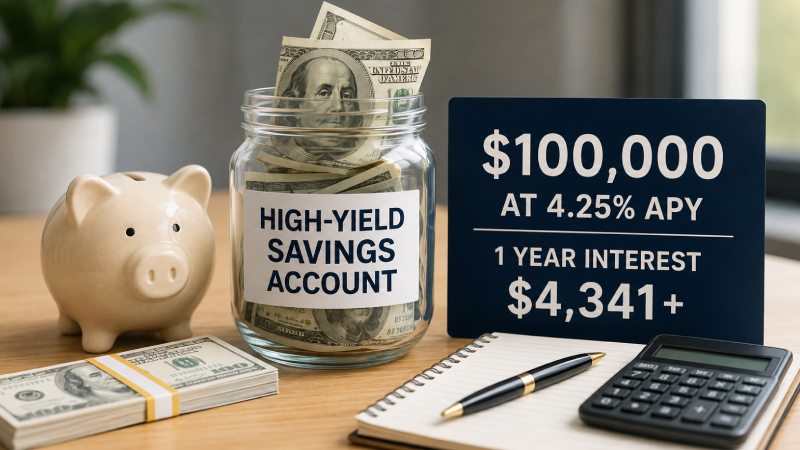
A $100,000 deposit in a top high-yield savings account (HYSA) will generate approximately $4,000 to $4,500 in interest over one year, assuming current market rates of 4.00% to 4.50% APY remain stable. At a standard 4.25% rate, you can expect roughly $354 per month in earnings.
While these accounts offer total principal safety through FDIC insurance up to $250,000, the returns are variable and subject to federal taxes.
This guide analyzes how compounding, inflation, and bank selection impact your six-figure balance to help you maximize your risk-free financial growth effectively today.
Calculating Your Yearly Interest on $100,000
Determining the exact return on a six-figure sum requires an understanding of how banks calculate and distribute earnings. The following sections break down the mathematical mechanics and the role of annual percentage yields.
The Power of Daily Compounding
High-yield savings accounts leverage compound interest, meaning you earn interest on your original deposit plus the interest you have already accumulated.
Most top-tier banks utilize daily compounding, which allows your money to snowball faster because the interest earned today starts earning its own interest tomorrow. Over a single year, a 4.25% rate on $100,000 results in $4,341.35 due to this frequency.
Interest Rates vs. APY Explained
While many people use the terms interchangeably, the Annual Percentage Yield (APY) reflects the real rate of return taking compounding into account.
For a $100,000 deposit, even a minor difference in APY can result in hundreds of dollars in additional annual income. It is essential to focus on the APY rather than the simple interest rate to understand the actual growth of your cash reserves.
HYSA Interest Calculator
*Calculations assume daily compounding interest at a fixed rate over the selected timeframe. Actual rates on high-yield savings accounts are variable.
Comparing Returns: Online Banks vs. Traditional Institutions
Choosing the right financial institution is the most significant factor in determining your yield. The data below illustrates the stark contrast between modern digital banks and traditional physical institutions.
| Account Type / Institution | Current APY Range | Estimated 1-Year Interest |
|---|---|---|
| Top-Tier Online HYSA (e.g., SoFi) | 4.25% – 4.50% | $4,250 – $4,500 |
| Average Online HYSA (e.g., CIT Bank) | 4.10% | $4,100 |
| National Average Account | 0.38% | $380 |
| Traditional Mega Bank (e.g., Chase) | 0.01% | $10 |
As shown in the table, placing $100,000 in a traditional brick-and-mortar bank is a costly mistake that could result in losing over $4,000 in potential earnings annually. Online banks offer superior rates because they lack the massive overhead costs associated with maintaining physical branch networks.
What Happens If You Put $100,000 in a High-Yield Savings Account?
Depositing a large sum into a high-yield environment triggers several automated banking processes. Understanding these mechanics ensures you are prepared for how your balance will fluctuate and remain protected over the long term.
Immediate Interest Generation
The moment your funds clear, the bank begins calculating your daily interest. While your balance only increases visibly once a month when the bank “drops” the payout into your account, the growth is happening behind the scenes every twenty-four hours.
This immediate start ensures that your $100,000 begins working for you without a waiting period or maturation delay common in other vehicles.
Guaranteed Principal Safety
Your $100,000 is 100% safe from bank defaults when held in a regulated institution. It is fully backed by the Federal Deposit Insurance Corporation (FDIC) or the National Credit Union Administration (NCUA), which protect up to $250,000 per person, per bank.
Because your deposit is well under this limit, you face zero risk of losing your principal, regardless of the bank’s internal financial health.
Can You Live Off the Interest of $100,000?
Many investors wonder if a six-figure balance provides enough passive income to cover basic expenses. While the interest is substantial, several external factors determine whether it can actually sustain a person’s lifestyle.
The Monthly Income Reality
At a strong 4.25% APY, $100,000 generates roughly $361 per month in interest. While this is a helpful supplement for a utility bill or groceries, it is far below the baseline cost of living in almost any geographic region.
Relying solely on this interest for housing, health care, and daily needs is not mathematically feasible in the current economic climate.
The Tax and Inflation Impact
The IRS treats savings interest as ordinary income, meaning you must pay taxes on your earnings annually. If you are in the 22% tax bracket, a $4,300 profit means you owe nearly $1,000 in federal taxes.
Additionally, if inflation runs at 3%, a 4.25% yield only provides a 1.25% real return, meaning your money’s buying power is barely keeping pace with rising costs.
How to Turn $100,000 into $1 Million in 5 Years?
Scaling a portfolio from six to seven figures within a half-decade is an ambitious goal. This process requires a departure from traditional savings methods in favor of high-velocity capital growth or significant contributions.
The Aggressive Monthly Savings Path
You can achieve $1 million by using your initial $100,000 as a launchpad and adding fresh capital every month.
If you invest the lump sum in a standard index fund averaging an 8% annual return, you must contribute an additional $11,500 every single month for five years to hit the million-dollar mark. This path prioritizes high-volume saving over market timing.
High-Risk Financial Leverage Options
To reach $1 million in five years without adding new money, you would need a staggering annualized return of roughly 58.5%. Achieving this requires high-risk strategies like trading equity options, funding early-stage startups, or using extreme debt leverage in commercial real estate.
However, these methods involve an immense risk of losing your entire $100,000 principal and are not recommended for most.
Crucial Financial Risks and Blind Spots
High-yield accounts are considered low-risk, but they are not entirely without external economic pressures. Investors must remain aware of how shifting market conditions and government policies can impact their net profit over time.
Variable Interest Rate Sensitivity
Unlike Certificates of Deposit (CDs), high-yield savings rates are variable and not locked in for a specific term. Banks typically adjust their APYs within days of a Federal Reserve benchmark interest rate cut.
This means your $4,300 annual projection could decrease significantly if the central bank decides to lower rates to stimulate the broader economy.
The Erosion of Real Purchasing Power
While your nominal balance increases every month, inflation acts as a hidden tax that erodes the value of your dollars. If the cost of goods increases faster than your bank’s interest rate, you are effectively losing wealth in terms of what that money can buy.
Investors must balance the safety of a savings account with other assets that historically outperform inflation over time.
Strategic Management of Large Cash Deposits
Managing a $100,000 balance requires more than just picking the highest rate; it involves liquidity planning and tax strategy. Below are the core operational steps for high-balance depositors:
- Maintain Liquidity: Ensure your chosen account offers at least six fee-free withdrawals per month to handle unexpected financial emergencies without penalty.
- Track Tax Liabilities: Prepare for a 1099-INT form every January, as the bank reports all interest earned to the IRS regardless of whether you withdraw it.
- Monitor Federal Reserve Shifts: Stay informed on economic data, as a shift in monetary policy will immediately impact your monthly interest checks.
- Verify Insurance Coverage: Double-check that your bank is FDIC-insured to guarantee that your $100,000 remains protected against institutional failure.
- Automate Growth: Set up your account so that monthly interest payouts are automatically reinvested to maximize the benefits of daily compounding.
Frequently Asked Questions
Is my $100,000 deposit safe in an online bank?
Yes, online banks carry the same FDIC or NCUA insurance as traditional banks. As long as the institution is regulated, your first $250,000 is fully protected by the federal government.
How often is the interest paid out?
While interest is calculated daily, most high-yield accounts deposit the accumulated earnings into your balance once a month. This creates a visible monthly “paycheck” that increases the principal for the following month’s calculations.
Do I have to pay taxes if I don’t withdraw the money?
Yes. The IRS considers interest “earned” in the year the bank credits it to your account. You will owe ordinary income tax on the full amount of interest generated, even if the funds remain in the account.
Can the bank change my interest rate without notice?
Yes, high-yield savings accounts have variable rates. Banks can lower or raise the APY at any time based on market conditions or changes to the federal funds rate.
What is the difference between a HYSA and a CD?
A HYSA offers liquidity, allowing you to withdraw money at any time. A Certificate of Deposit (CD) usually offers a fixed rate but requires you to lock your money away for a specific term, often charging a penalty for early access.
Summary of Six-Figure Savings Potential
Maximizing a $100,000 windfall requires moving beyond traditional banking and embracing high-yield digital platforms. By securing a 4.25% APY, you can generate over $4,300 in annual passive income while maintaining 100% principal safety through FDIC insurance.
However, it is vital to remain realistic; this interest is rarely enough to sustain a lifestyle and is subject to both taxes and inflation.
For most, a high-yield account serves as the perfect low-risk foundation for a broader financial strategy, providing the safety and liquidity needed to pursue more aggressive growth opportunities elsewhere.
Always monitor interest rate trends and consult with a tax professional to ensure your six-figure balance continues to serve your long-term wealth goals effectively.