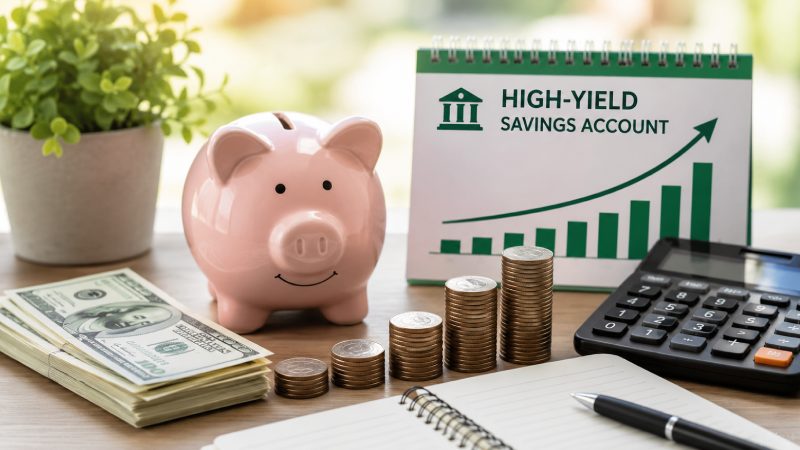
A $1,000 deposit in a high-yield savings account (HYSA) will make approximately $40 to $45 in interest over the course of one year.
With top-tier online institutions currently offering Annual Percentage Yields (APY) between 4.00% and 4.50%, your capital earns significantly more than it would in traditional retail banks that often pay as little as 0.01%.
This strategy provides a low-risk environment for cash preservation while benefiting from federal insurance protection up to $250,000. Maximizing these returns requires understanding compounding frequencies and the impact of variable interest rates on your long-term growth.
Direct Earnings Breakdown on a $1,000 Principal
Navigating the complexities of modern banking requires a clear understanding of how different interest rates impact your final balance over several years of consistent saving and compounding.
Returns at 4.00% APY
At a 4.00% APY, your initial $1,000 deposit will generate $40.00 in interest after twelve months. If the funds remain untouched for three years, the total balance grows to $1,124.86, ultimately reaching $1,216.65 after five years.
This level of return is essential for maintaining an emergency fund that works as hard as you do, providing a steady stream of passive income without risking your principal in volatile markets.
Returns at 4.25% APY
Choosing an account with a 4.25% APY increases your first-year earnings to $42.50. Over longer horizons, the power of compound interest becomes more evident; your balance would reach $1,133.00 after three years and $1,231.35 after five years.
These incremental gains highlight why even a small difference in decimal points can lead to significantly higher wealth accumulation when looking at your total financial picture over several years.
Returns at 4.50% APY
At the top of the current market, a 4.50% APY nets you $45.00 in interest annually. By the end of a five-year period, your $1,000 grows into $1,246.18, assuming the baseline principal remains untouched.
This rate represents some of the most aggressive passive growth available in a liquid, federally insured environment, making it the gold standard for savers who prioritize both high yields and immediate access to their cash.
High-Yield Savings Account (HYSA) Calculator
Comparing High-Yield Options to Traditional Institutions
The gap between modern online banking and legacy retail institutions is wider than many realize, creating a significant opportunity cost for those who remain loyal to old-fashioned accounts.
The Underperformance of Traditional Mega-Banks
Traditional mega-banks like Chase or Bank of America typically offer a meager 0.01% APY on standard savings accounts. This results in a return of just ten cents ($0.10) on a $1,000 deposit after a full year.
Staying with these institutions effectively costs you over $40 in potential earnings annually, as your money fails to keep pace with even the most modest economic growth or interest rate trends.
Online Banks and the Efficiency Gap
Top-tier digital platforms such as SoFi, offering up to 4.50% APY, or OMB Bank, offering 4.26% APY, provide over 11 times more income than the national average bank.
Because these institutions do not have the overhead costs of physical branches, they pass those savings directly to you in the form of higher interest rates. This efficiency gap is the primary reason why digital-first banking has become the preferred choice for sophisticated savers.
Why the National Average is Deceptive
The national average savings rate currently sits at approximately 0.38% APY, which would generate only $3.80 on your $1,000 deposit. While this is higher than the lowest tier of mega-banks, it still falls drastically short of what high-yield accounts offer.
Relying on average rates means leaving money on the table, as top-performing accounts consistently outperform the median by a factor of ten or more in current markets.
The Mathematical Mechanics of Account Growth
Understanding the underlying mechanics of how interest is calculated and protected is vital for anyone looking to optimize their cash reserves and ensure long-term stability.
Understanding Compounding Frequency
The frequency at which a bank calculates interest—daily versus monthly—can slightly shift your total earnings over time. Daily compounding allows your money to grow at the fastest mathematically possible clip because you begin earning interest on your interest almost immediately.
While the difference on $1,000 might seem small initially, it becomes a powerful driver of wealth as your balance grows into five or six figures.
The Role of Variable APY in Market Fluctuations
It is important to remember that high-yield savings rates are variable and tied to the Federal Reserve’s benchmark interest rates. Unlike a Certificate of Deposit (CD), your HYSA rate is not permanently locked and can fluctuate dynamically based on macroeconomic shifts.
If central rates drop, your bank’s yield will likely follow, which means you should monitor market trends to ensure your money remains in a competitive account.
Security through FDIC and NCUA Insurance
One of the greatest benefits of an HYSA is the absence of market risk, provided the institution is explicitly backed by the FDIC or NCUA. This federal guarantee protects your deposit balance up to $250,000 per person, per institution, against bank failure.
This “no-loss” reality makes high-yield savings a cornerstone of a healthy financial plan, offering a safe harbor for your most critical liquid assets.
Operational Realities and Financial Blind Spots
While the benefits are numerous, savvy savers must account for external factors like taxes and inflation that can impact the real-world value of their interest earnings.
Navigating Annual Tax Obligations
Interest earned in a savings account is treated as ordinary taxable income by the IRS. If you earn more than $10 in a calendar year, your bank will issue a 1099-INT form, which must be reported on your tax return.
It is wise to set aside a small portion of your interest profits to cover potential tax liabilities, ensuring that your net gains align with your expectations.
Balancing Liquidity and Growth
Unlike stock market investments or physical assets, a high-yield account offers immediate liquidity, allowing you to withdraw cash instantly during emergencies. This accessibility is a major advantage for $1,000 deposits intended for an emergency fund.
However, the trade-off for this liquidity is a lower return compared to more aggressive investment vehicles that require you to lock your money away for longer durations.
Addressing the Inflation Erosion Factor
While the numerical balance in your account grows, inflation can decrease the actual purchasing power of those dollars over long periods. Over a 20-to-30-year horizon, $1,000,000 might feel more like $500,000 in today’s economy.
Therefore, an HYSA should be viewed as a tool for short-term goals and emergency stability rather than a sole vehicle for long-term wealth preservation against rising costs of living.
Scaling Your $1,000 Toward Long-Term Wealth
Starting with $1,000 is an excellent first step, but the true power of high-yield savings is unlocked when it is used as a foundation for a broader financial strategy.
Savings as a Foundation for Investing
A high-yield account is an excellent tool for storing cash, but it typically does not yield returns high enough to build massive wealth quickly on its own.
To reach major milestones, such as a million-dollar net worth, you must eventually transition from pure saving to strategic investing. Using your HYSA as a “launchpad” ensures you have a secure base before taking on the risks of the stock market.
Accelerating the Timeline to Seven Figures
If you invest $1,000 monthly alongside your initial $1,000, reaching a million dollars in an HYSA at 4.5% APY would take approximately 34.6 years.
By moving toward aggressive stock market index funds with a 10% average return, that timeline can be shortened to 22.3 years. This comparison illustrates how different asset classes serve different roles in your journey from a $1,000 deposit to a substantial legacy.
The Risk Profile of Market Diversification
While the stock market offers faster growth, it also introduces the risk of principal loss, which is not present in an FDIC-insured HYSA. Diversifying your capital between high-yield savings for security and index funds for growth provides a balanced risk profile.
This dual approach allows you to capitalize on compound interest while maintaining the peace of mind that your core $1,000 principal is protected.
Top Strategies to Maximize Your $1,000 Deposit
To ensure you are getting the absolute most out of your capital, follow these evidence-based best practices for managing your high-yield savings:
- Automate Contributions: Set up a monthly transfer to grow your balance beyond the initial $1,000, accelerating the effects of compounding.
- Monitor APY Trends: Check your account’s rate quarterly to ensure it remains competitive with the top-tier market leaders.
- Look for Daily Compounding: Prioritize banks that compound interest daily rather than monthly to squeeze every cent of growth out of your principal.
- Verify Federal Insurance: Never deposit funds into an institution that is not explicitly verified by the FDIC or NCUA.
- Maintain an Emergency Buffer: Use the high liquidity of the account to keep at least three to six months of expenses accessible at all times.
- Track Tax Documents: Keep a digital folder for your 1099-INT forms to simplify your filing process at the end of the year.
Frequently Asked Questions
What happens if I put $1,000 in a high-yield savings account?
When you deposit $1,000, your principal is legally protected by the federal government while earning aggressive interest, typically netting you $40 to $45 annually. Your money remains liquid, meaning you can withdraw it at any time without penalty, unlike many other investment types.
How long will it take to become a millionaire if I invest $1,000 a month?
Starting with $1,000 and contributing $1,000 monthly, it takes about 34.6 years in an HYSA at 4.5% APY. If you choose aggressive stock market investing with a 10% return, the timeline drops to 22.3 years.
Is my money safe in an online high-yield account?
Yes, as long as the bank is FDIC-insured or the credit union is NCUA-insured, your deposits are protected up to $250,000. This makes it one of the safest places to store cash while still earning a return.
Start Building Your Financial Future Today
The difference between earning $0.10 and $45.00 a year might seem small on a $1,000 scale, but it represents a fundamental shift in how you manage your capital. By choosing a high-yield savings account, you are taking an active step toward financial efficiency and wealth accumulation.
Move your funds into a top-tier account today and let the power of compound interest begin working in your favor. Consistent saving, paired with the right banking tools, is the most reliable path to achieving your long-term economic goals.