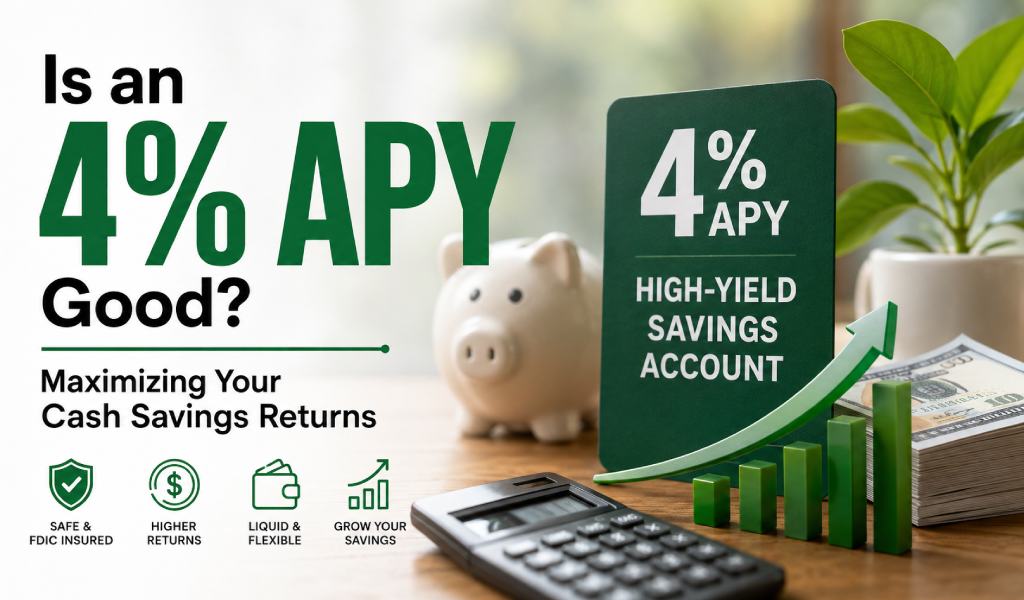

Depositing $50,000 into a high-yield savings account (HYSA) safely generates approximately $2,000 to $2,250 in passive interest during the first year, assuming a competitive annual percentage yield between 4.00% and 4.50%.
Beyond the immediate cash earnings, your principal balance remains fully liquid and 100% federally protected by the FDIC or NCUA up to $250,000. This financial move ensures your capital grows daily while remaining accessible for emergencies or upcoming major purchases.
However, factors like variable rates, inflation, and income taxes are critical considerations for maximizing the long-term effectiveness of your $50,000 deposit.
How Much Will $50,000 Make in a High-Yield Savings Account?
When you evaluate the potential of a $50,000 cash injection, the primary driver of growth is the compounding frequency and the interest rate environment. Unlike traditional accounts, these vehicles utilize competitive yields to combat the eroding effects of inflation on your buying power.
The Impact of Daily Compounding Interest
The most efficient savings vehicles today use daily compounding, which means you earn interest on your original deposit plus the interest already earned every single day. At a top-tier rate of 4.15% APY, a $50,000 deposit yields a consistent upward trajectory.
Within just one month, your balance increases by approximately $173, and by the six-month mark, you have earned over $1,048 in purely passive income. This creates a snowball effect where your money works harder for you as the balance grows.
Projected Growth Over Long Horizons
While the immediate monthly gains are impressive, the true power of an HYSA is revealed over several years. If the rate remains steady at 4.15%, your $50,000 will grow to $52,112 in one year and reach $56,512 after three years.
Over a five-year period, your earnings total approximately $11,273, bringing your ending balance to $61,273. Over twenty years at a projected 4.00% long-term average, your initial capital could double to nearly $109,556, though it is important to note that bank rates fluctuate over such long durations.
📊 HYSA Compound Interest Calculator
Adjust your deposit, APY rate, and time horizon to see how your money grows over time:
💡 A traditional big bank (0.01% APY) would yield only: $0.00
High-Yield Earnings and Compounding Benchmarks
The following data illustrates the specific growth path for a $50,000 deposit at a competitive 4.15% APY compared to lower-yield options.
| Timeline | Total Interest Earned | New Account Balance |
|---|---|---|
| 1 Month | ~$173 | $50,173 |
| 6 Months | ~$1,048 | $51,048 |
| 1 Year | ~$2,112 | $52,112 |
| 3 Years | ~$6,512 | $56,512 |
| 5 Years | ~$11,273 | $61,273 |
| 20 Years | ~$59,556 | $109,556 |
Is $50,000 Too Much to Keep in Savings?
Determining if a $50,000 balance is excessive for a bank account depends entirely on your personal liquidity needs and upcoming financial obligations. Financial experts often suggest that cash is only “too much” when it exceeds its intended purpose, such as an emergency fund or a specific short-term goal.
Assessing Your Liquidity Requirements
If your monthly household expenses total $8,000, then a $50,000 balance serves as a robust six-month emergency fund, which is a cornerstone of financial security.
Additionally, if you are planning to use this capital for a home down payment or a major wedding within the next two to three years, keeping it in a liquid HYSA is the most responsible choice. It ensures the principal is protected from market volatility while still outperforming the national average interest rate of 0.38% to 0.61%.
The Risk of Opportunity Cost
Keeping excessive cash beyond your emergency needs can lead to a significant opportunity cost. While a bank account is safe, it rarely matches the long-term returns of the stock market.
For example, $50,000 left in an HYSA for 20 years might grow to $109,556, but the same amount invested in a diversified S&P 500 index fund could reach $233,047 based on an 8.00% average return.
For long-term wealth building, any cash not needed for five or more years should typically be moved into growth-oriented assets to outpace inflation.
Understanding Security and Federal Protections
One of the most compelling reasons to utilize a high-yield account for $50,000 is the unparalleled level of security provided by government backing. This ensures that even in the face of economic instability, your fundamental capital is never at risk.
Federal Insurance and Default Protection
Your $50,000 deposit is 100% secured up to $250,000 per depositor, per insured bank. This protection is managed by the Federal Deposit Insurance Corporation (FDIC) for banks or the National Credit Union Administration (NCUA) for credit unions.
In the rare event that your financial institution faces a total collapse, the federal government legally guarantees that you will receive your full principal and accrued interest back, providing a safety net that assets like stocks or cryptocurrencies cannot offer.
Unrestricted Capital Liquidity
A primary advantage of the HYSA over other fixed-income vehicles, such as Certificates of Deposit (CDs), is the lack of liquidity constraints. You can move your money at any time via external ACH transfers, wire requests, or mobile payment apps without incurring early withdrawal penalties.
This makes it an ideal landing spot for $50,000 that needs to remain “ready for action,” whether that means jumping on a business opportunity or covering a sudden medical expense.
Comparing Cash Strategy Options in 2026
Choosing where to park $50,000 requires balancing your need for high returns against your need for immediate access to funds.
| Vehicle Type | Average Yield | Liquidity Level | Primary Risk |
|---|---|---|---|
| High-Yield Savings | 4.00% – 4.50% | High (Flexible) | Rates drop if Fed cuts rates |
| Traditional Savings | 0.01% – 0.61% | High (Flexible) | Significant loss of buying power |
| 1-Year Fixed CD | 4.10% – 4.40% | Locked (12 months) | Heavy penalties for early access |
| Treasury Bills | 3.90% – 4.20% | Medium | Market access required |
| S&P 500 Index | 7.00% – 10.00% | High (1-day settle) | Principal loss in downturns |
What Is the Smartest Thing to Do with $50,000?
A $50,000 windfall or savings milestone offers a unique chance to reset your financial trajectory. Instead of viewing it as a single block of money, the most effective strategy involves splitting the funds into specialized “buckets” to maximize both security and growth.
Eradicating High-Interest Debt First
Before letting your money sit in a bank account, look for any toxic debt, such as credit card balances or personal loans with interest rates exceeding 7%. Eliminating a loan with a 20% APR is financially equivalent to earning a guaranteed, tax-free 20% return on your investment.
By paying off high-interest debt, you immediately increase your monthly cash flow and net worth more effectively than any savings account ever could.
Maximizing Tax-Advantaged Growth
Once your high-interest debt is cleared and your emergency fund is established in an HYSA, use the remaining funds to jumpstart your retirement compounding. Fully funding a Roth IRA or contributing more to a workplace 401(k) allows your money to grow while shielded from capital gains taxes.
This strategy leverages the $50,000 to build long-term wealth that will far exceed the simple interest earned in a standard savings account over several decades.
Critical Strategic Blind Spots to Avoid
While $50,000 in an HYSA is a low-risk move, there are several subtle “traps” and economic factors that can diminish the value of your savings if you are not vigilant.
The Inflation Drag on Cash
The most persistent threat to a $50,000 cash balance is inflation. While your account balance may go up every month, the “real-world” purchasing power of those dollars may decrease if the cost of goods and services rises faster than your interest rate.
Over long periods, pure cash positions often lose value relative to the economy, which is why it is essential to balance your HYSA with assets that historically outpace inflation, like diversified index funds.
Tiered Rates and Promotional Teasers
Many financial institutions use aggressive marketing to attract large deposits like $50,000. Be cautious of “tiered rate” traps, where a bank advertises a 5.00% APY but only applies it to the first $5,000 of your balance, dropping the remainder to a negligible rate.
Similarly, watch for introductory promotional “boosts” that expire after a few months. Always audit the fine print to ensure the competitive rate applies to your entire $50,000 balance for the foreseeable future.
Managing Taxes and Variable Rate Fluctuations
Your earnings on a $50,000 deposit are not entirely “free” money, as the government views interest as unearned income. Furthermore, the rate you sign up for today is rarely the rate you will have next year.
Federal and State Tax Obligations
The interest generated by your $50,000—potentially over $2,000 a year—is treated as standard income by the IRS. Your bank will issue a Form 1099-INT if you earn more than $10 in interest, and you must report this on your taxes.
Depending on your marginal tax bracket, a significant portion of those earnings might go toward federal and state taxes, so it is wise to set aside a small portion of your interest for the tax season.
The Influence of the Federal Reserve
High-yield savings rates are dynamic and peg directly to the Federal Reserve’s benchmark rate. If macroeconomic conditions shift and the Fed decides to lower interest rates to stimulate the economy, your bank will likely follow suit by dropping your APY.
Unlike a Certificate of Deposit, which locks in a rate for a set term, an HYSA rate is variable and can change at any time, meaning your monthly passive income could decrease without warning.
Final Thoughts on Maximizing Your $50,000
Putting $50,000 in a high-yield savings account is one of the safest and most effective ways to preserve capital while earning a meaningful return. It provides a level of liquidity and federal protection that is hard to match with other investment vehicles.
However, the smartest approach is to treat this account as a temporary home for short-term goals or as a foundational emergency fund.
For long-term financial independence, combining the security of an HYSA with the growth potential of tax-advantaged investments ensures that your $50,000 works as hard as possible for your future.
Frequently Asked Questions
How much interest does $50,000 earn per month?
At a 4.15% APY, you will earn roughly $173 per month in passive interest.
Will I lose money if the bank fails?
No, as long as the bank is FDIC or NCUA insured, your $50,000 is 100% protected by the federal government up to $250,000.
Should I choose a CD or an HYSA for $50,000?
Choose an HYSA if you need immediate access to your money for emergencies. Choose a CD if you want to “lock in” a high interest rate and do not plan to touch the money for at least 12 months.